
Blog
3 Easy Ways to Identify an Original Handloom Saree Before You Buy
Handloom sarees are valued for their craftsmanship, traditional weaving techniques, distinctive textures, and the skill involved in creating them. However, with so many sarees available online and in stores, it can sometimes be difficult to tell whether a saree is genuinely handwoven or simply designed to look like one.
If you are planning to buy a handloom saree, knowing how to identify an original handloom saree can help you make a more informed purchase.
The good news is that you do not always need expert knowledge. By paying attention to the weave, fabric, design details, product information, and authenticity credentials, you can identify several useful indicators of a genuine handloom saree.
Here are 3 easy ways to identify an original handloom saree before you buy.
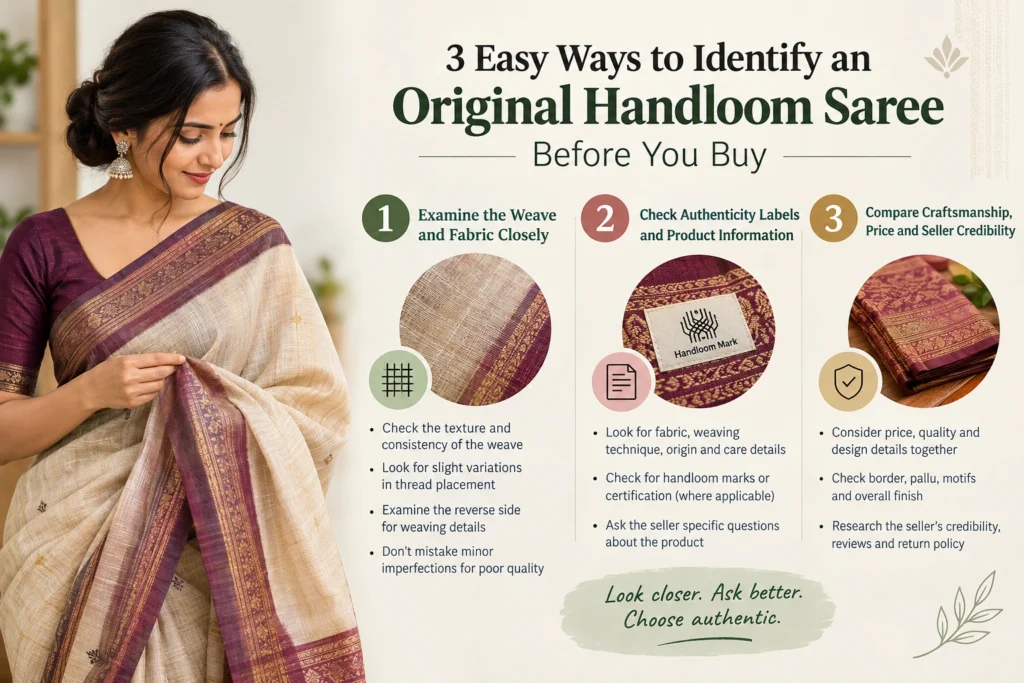
1. Examine the Weave and Fabric Closely
One of the first things to check when trying to identify an original handloom saree is the fabric and weave.
Handloom weaving involves manual handling of yarns on a loom. Because of this process, authentic handwoven fabrics can sometimes display subtle variations in texture, thread placement, or pattern alignment.
These variations are not necessarily flaws. In many cases, they are characteristics of the weaving process.
What to Look For
When examining a saree, pay attention to:
- The texture of the fabric
- Consistency of the weave
- Slight variations in thread placement
- Fine details in woven motifs
- The relationship between the body, border, and pallu
- The way the fabric falls and drapes
A genuine handwoven saree may not look mechanically identical at every point. However, the overall weaving should still appear carefully executed and balanced.
Check the Reverse Side
If possible, examine the reverse side of the saree.
Look closely at the border, motifs, and areas containing intricate designs. Depending on the weaving technique, the back may provide useful clues about how the design has been constructed.
However, there is no single visual test that can authenticate every handloom saree. Different weaving traditions use different techniques, so the appearance of the reverse side can vary.
Don't Mistake Imperfections for Poor Quality
A common misconception is that every handloom saree should have visible irregularities.
That is not necessarily true.
Skilled weavers can produce highly precise and consistent fabrics. Similarly, some machine-made fabrics can intentionally reproduce irregular textures.
Therefore, weave characteristics should be considered alongside other authenticity indicators rather than used as the only test.
2. Check Authenticity Labels and Product Information
The second important step in learning how to identify an original handloom saree is checking the information provided by the seller.
When purchasing a handloom saree, especially online, look for clear details about the product.
Important Information to Check
A reliable product listing should ideally explain:
| Information | Why It Matters |
|---|---|
| Fabric | Helps you understand whether the saree is cotton, silk, or another material |
| Weaving technique | Provides information about how the saree was produced |
| Origin | Can indicate the traditional weaving region |
| Artisan/craft details | Gives more context about the craftsmanship |
| Saree dimensions | Helps verify the actual product specifications |
| Care instructions | Helps you maintain the saree correctly |
| Authenticity credentials | Can provide additional confidence when applicable |
Be cautious when a product is described only with words such as “traditional,” “designer,” or “ethnic” without providing meaningful information about the fabric or weaving process.
Look for Handloom Mark or Applicable Certification
Depending on the product and market, recognized handloom identification or certification marks can provide additional information about authenticity.
In India, the Handloom Mark is associated with genuine handwoven products and is intended to help consumers distinguish handloom products from non-handloom alternatives.
When purchasing a saree advertised as handloom, check whether the seller provides relevant certification or product documentation where applicable.
Ask Questions Before Buying
If product information is unclear, ask the seller directly.
Useful questions include:
- What is the fabric composition?
- Is this saree handwoven?
- Where was it woven?
- How should it be maintained?
- What weaving technique was used?
- Is it made by hand on a traditional loom?
- Does it have any applicable authenticity certification?
A seller who provides specific, consistent product information can make the buying process easier and more transparent.
2. Check Authenticity Labels and Product Information
The second important step in learning how to identify an original handloom saree is checking the information provided by the seller.
When purchasing a handloom saree, especially online, look for clear details about the product.
Important Information to Check
A reliable product listing should ideally explain:
| Information | Why It Matters |
|---|---|
| Fabric | Helps you understand whether the saree is cotton, silk, or another material |
| Weaving technique | Provides information about how the saree was produced |
| Origin | Can indicate the traditional weaving region |
| Artisan/craft details | Gives more context about the craftsmanship |
| Saree dimensions | Helps verify the actual product specifications |
| Care instructions | Helps you maintain the saree correctly |
| Authenticity credentials | Can provide additional confidence when applicable |
Be cautious when a product is described only with words such as “traditional,” “designer,” or “ethnic” without providing meaningful information about the fabric or weaving process.
Look for Handloom Mark or Applicable Certification
Depending on the product and market, recognized handloom identification or certification marks can provide additional information about authenticity.
In India, the Handloom Mark is associated with genuine handwoven products and is intended to help consumers distinguish handloom products from non-handloom alternatives.
When purchasing a saree advertised as handloom, check whether the seller provides relevant certification or product documentation where applicable.
Ask Questions Before Buying
If product information is unclear, ask the seller directly.
Useful questions include:
- What is the fabric composition?
- Is this saree handwoven?
- Where was it woven?
- How should it be maintained?
- What weaving technique was used?
- Is it made by hand on a traditional loom?
- Does it have any applicable authenticity certification?
A seller who provides specific, consistent product information can make the buying process easier and more transparent.
3. Compare Craftsmanship, Price, and Seller Credibility
The third way to identify an original handloom saree is to look at the complete picture rather than focusing on one feature.
Price, craftsmanship, seller transparency, and product details should all be considered together.
Don't Assume a Cheap Saree Is a Bargain
Authentic handloom sarees can vary widely in price.
The price may depend on:
- Type of yarn
- Fabric quality
- Weaving technique
- Design complexity
- Rarity of the weaving tradition
- Time required for weaving
- Artisan skill
- Zari or decorative work
- Finishing
For example, a simple cotton handloom saree and a highly detailed silk handloom saree will naturally have different production costs.
An unusually low price for a product described as a premium, highly intricate handloom saree may justify asking additional questions about its material and production method.
At the same time, price alone does not prove authenticity. An expensive saree is not automatically a genuine handloom saree.
Examine the Craftsmanship
Look closely at the details.
A well-made handloom saree should demonstrate attention to:
- Border alignment
- Pallu construction
- Motif placement
- Thread quality
- Colour consistency
- Fabric finishing
- Overall drape
Intricate traditional designs often require considerable skill and time.
For example, sarees featuring detailed borders and pallus may require more complex weaving than simpler designs.
Research the Seller
The seller is an important part of the purchasing decision, particularly when buying online.
Before purchasing, look for:
- Detailed product descriptions
- Clear fabric specifications
- Transparent return policies
- Thread quality
- Colour consistency
- Fabric finishing
- Overall drape
When purchasing a saree advertised as handloom, check whether the seller provides relevant certification or product documentation where applicable.
Ask Questions Before Buying
If product information is unclear, ask the seller directly.
Useful questions include:
- What is the fabric composition?
- Is this saree handwoven?
- Where was it woven?
- Authentic product photographs
- Information about the weaving tradition
- Customer reviews
- Business contact details
- Clear care instructions
A seller that provides detailed information about the saree makes it easier for customers to understand what they are purchasing.
Handloom Saree vs Machine-Made Saree
Understanding the difference between handloom and machine-made sarees can make the buying process easier.
| Feature | Handloom Saree | Machine-Made Saree |
|---|---|---|
| Production | Woven using a handloom | Produced using industrial machinery |
| Artisan involvement | Significant | More automated |
| Production speed | Generally slower | Generally faster |
| Texture | Can have distinctive woven characteristics | Usually more mechanically uniform |
| Design | Can feature traditional weaving techniques | Can reproduce many designs |
| Production volume | Usually lower | Usually higher |
It is important to remember that machine-made does not automatically mean low quality.
Machine-made sarees can also be attractive, durable, and well-designed. The important point is to ensure that the product is accurately described.
If you are specifically looking for a handloom saree, the key is transparency about how the fabric was produced.
Common Myths About Identifying Handloom Sarees
There are several popular “tests” for identifying handloom sarees that should be approached carefully.
Myth 1: Every Handloom Saree Must Have Visible Irregularities
Not necessarily.
Different weavers, looms, materials, and weaving techniques can produce different results. Skilled craftsmanship can also create highly consistent fabrics.
Myth 2: A Handloom Saree Must Be Expensive
Price depends on numerous factors.
A simple handwoven cotton saree may cost much less than an elaborate silk saree with intricate weaving and zari work.
Myth 3: You Can Always Identify Handloom by Touch Alone
Texture can provide clues, but touch alone is not a definitive authentication method.
Fabric composition, finishing, weaving technique, and design can all affect how a saree feels.
Myth 4: A Traditional Design Means the Saree Is Handwoven
A traditional pattern can be reproduced using different production methods.
Therefore, the design itself does not prove that a saree was made on a handloom.
How to Buy an Authentic Handloom Saree Online
Buying online is convenient, but you cannot physically examine the saree before placing an order. This makes product information particularly important.
Before purchasing, follow this simple checklist:
- Read the complete product description.
- Check the fabric composition.
- Look for specific information about the weaving technique.
- Examine product photographs carefully.
- Check customer feedback where available.
- Check the border and pallu details.
- Look for relevant authenticity information.
- Compare the product specifications with similar sarees.
- Review the seller's return and exchange policy.
- Ask questions if any product detail is unclear.
Questions to Ask an Online Seller
If you are uncertain about a product, you can ask:
“Is this saree completely handwoven?”
“What fabric is used?”
“Which weaving tradition or technique is used?”
“Where is the saree woven?”
“Is any authenticity certification available?”
These questions can help you understand the product before making a purchase.
How to Choose Between Different Handloom Sarees
Once you have established that a saree is genuinely handwoven, your next decision is finding one that suits your needs.
For Everyday Wear
Consider lightweight cotton or other breathable handloom fabrics with simpler designs.
For Festive Occasions
Look for richer colours, detailed borders, and distinctive pallus.
For Weddings
Silk handloom sarees with elaborate motifs, traditional borders, and zari details can be suitable for formal celebrations.
For Long-Term Investment
Focus on fabric quality, craftsmanship, timeless designs, and proper maintenance rather than choosing solely based on current trends.
A Simple 3-Step Handloom Saree Authenticity Checklist
Before buying, remember these three steps:
Step 1: Check the Weave
Examine the texture, fabric, motifs, border, and pallu.
Step 2: Check the Information
Look for fabric details, weaving technique, origin, and applicable authenticity credentials.
Step 3: Check the Seller
Consider product transparency, craftsmanship, pricing, reviews, and return policies.
Using all three checks together is much more reliable than relying on a single “handloom test.”
Final Thoughts
Knowing how to identify an original handloom saree can help you shop with greater confidence.
Start by examining the weave and fabric, then check the product information and relevant authenticity credentials. Finally, consider the craftsmanship, price, and credibility of the seller.
Most importantly, do not rely on a single characteristic. Authenticity is better assessed by looking at several factors together.
Whether you are buying a lightweight cotton saree for everyday use or an elaborate silk handloom saree for a special occasion, understanding the craftsmanship behind the product can help you choose a saree that matches your expectations for quality, authenticity, and value.
Frequently Asked Questions
1. How can I identify an original handloom saree?
Check the weave and fabric, review the product’s weaving and material information, look for applicable authenticity credentials, and assess the seller’s transparency.
2. Can I identify a handloom saree by looking at the reverse side?
The reverse side can provide useful clues about the weaving technique and construction, particularly around intricate motifs and borders. However, it is not a universal authentication test.
3. Are original handloom sarees always expensive?
No. Handloom saree prices vary depending on fabric, weaving technique, design complexity, artisan skill, and finishing. Simple cotton handlooms can be more affordable than elaborate silk sarees.
4. Does an uneven weave prove that a saree is handloom?
No. Subtle variations may occur in handwoven fabrics, but unevenness alone does not prove authenticity. Other factors should also be considered.
5. How can I check whether an online handloom saree is genuine?
Check the fabric composition, weaving details, origin, applicable certifications, product photographs, seller information, and return policy. Contact the seller if important details are missing.
6. Is a traditional saree design proof that it is handwoven?
No. Traditional designs can be reproduced using different production methods. The production process and product information are more important indicators.
7. What should I check before buying a pure handloom saree?
Check the fabric, weaving technique, craftsmanship, authenticity information, dimensions, care instructions, seller credibility, and price. This gives you a more complete understanding of the product before purchasing.