Blog
Where Does the Kanjivaram Saree Come From? History, Weaving & Heritage
Few Indian sarees carry the same combination of craftsmanship, history, and cultural significance as the Kanjivaram saree. Known for its rich silk, distinctive borders, intricate motifs, and traditional zari work, it has become one of India's most recognised saree traditions.
But where does the Kanjivaram saree actually come from?
The answer leads to Kanchipuram in Tamil Nadu, a historic temple town that has been associated with silk weaving for generations. The saree’s identity is closely connected to the region, its weaving communities, traditional techniques, South Indian temple culture, and the craftsmanship passed from one generation to another.
Understanding the Kanjivaram saree history makes it easier to appreciate why these sarees can take considerable time to produce and why authentic pieces are valued for more than their appearance.
Where Does the Kanjivaram Saree Come From?
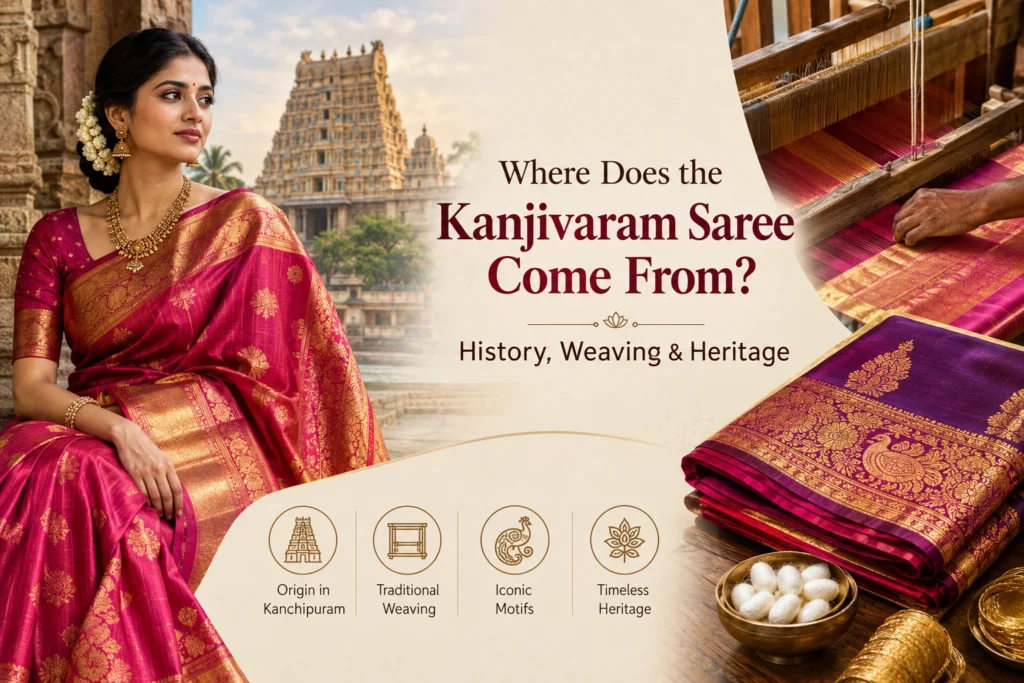
The Kanjivaram saree originates from Kanchipuram, a historic town in Tamil Nadu, India.
Kanchipuram has long been an important centre of temples, culture, and textile craftsmanship. Over generations, skilled weaving communities developed and refined techniques for producing richly woven silk sarees.
The name “Kanjivaram” is derived from Kanchipuram, while “Kanjeevaram” is another commonly used spelling.
The region’s connection to silk weaving is an important part of the saree’s identity. Today, Kanjivaram sarees remain strongly associated with Tamil Nadu and are particularly popular for weddings, religious celebrations, festivals, and other important occasions.
The History of the Kanjivaram Saree
The history of the Kanjivaram saree is closely connected to the development of silk weaving in Kanchipuram.
Kanchipuram’s importance as a religious and cultural centre created an environment in which textile traditions could flourish. Weaving communities contributed their knowledge and techniques to the development of distinctive silk sarees.
Traditional accounts also associate the migration of certain weaving communities to South India with the development of silk weaving traditions in the region. Over time, these communities established strong weaving traditions in Kanchipuram.
The saree evolved through generations of experimentation with:
- Silk yarn
- Zari
- Temple-inspired motifs
- Geometric patterns
- Contrasting borders
- Elaborate pallus
- Traditional weaving techniques
The result was a saree that developed a distinctive visual identity of its own.
Why Is Kanchipuram Important to Kanjivaram Sarees?
The connection between the saree and its place of origin is fundamental.
Kanchipuram is not simply a location where these sarees are produced. Its cultural environment has influenced the designs, motifs, colours, weaving traditions, and identity of the textile.
The town is famous for its temples, many of which feature elaborate architecture and sculptural details. These visual influences can be seen in traditional textile motifs.
The relationship between place and craft is one reason the Kanjivaram saree heritage remains so important.
How Is a Kanjivaram Saree Woven?
Traditional Kanjivaram saree weaving is a detailed process that requires considerable skill.
Unlike mass-produced fabrics, a traditional handloom saree involves substantial manual work.
1. Selecting the Silk
Traditional Kanjivaram sarees are associated with silk, and the quality of the silk yarn plays an important role in the finished fabric.
The yarn needs to be prepared appropriately before weaving.
2. Preparing the Warp
The warp consists of the lengthwise threads that form the foundation of the fabric.
Preparing these threads requires careful alignment and tension. The arrangement must be precise because errors at this stage can affect the finished saree.
Why Is Kanchipuram Important to Kanjivaram Sarees?
The connection between the saree and its place of origin is fundamental.
Kanchipuram is not simply a location where these sarees are produced. Its cultural environment has influenced the designs, motifs, colours, weaving traditions, and identity of the textile.
The town is famous for its temples, many of which feature elaborate architecture and sculptural details. These visual influences can be seen in traditional textile motifs.
The relationship between place and craft is one reason the Kanjivaram saree heritage remains so important.
Modern imitation zari can look remarkably similar to genuine metallic zari, particularly when viewed from a distance.
How Is a Kanjivaram Saree Woven?
Why Is Imitation Zari Used?
Imitation zari allows manufacturers and weavers to create decorative sarees at different price points.
It can be useful when:
- A customer wants a metallic appearance at a lower price.
- The saree is intended for occasional use.
- The design requires extensive zari work.
- The product is positioned as a more accessible alternative
- The manufacturer wants greater flexibility in material selection.
Using imitation zari does not automatically mean that a saree is poorly made. The quality of the weaving, fabric, design, and finishing still matters.
The key is that the material should be accurately represented to the customer.
What Makes Kanjivaram Silk Different?
One of the defining characteristics of a traditional Kanjivaram silk saree is its substantial silk fabric.
Compared with many lightweight sarees, traditional Kanjivaram silk often has a rich body and distinctive drape.
The saree’s visual appeal comes from the combination of:
- Rich silk texture
- Bold colour combinations
- Contrasting borders
- Elaborate pallus
- Metallic zari
- Traditional motifs
- Dense weaving
The exact appearance varies depending on the design and weaving tradition.
Traditional Kanjivaram Saree Motifs
One of the most fascinating aspects of Kanjivaram saree craftsmanship is its range of motifs.
Many designs draw inspiration from South Indian cultural and architectural traditions.
Common motifs include:
Temple-Inspired Designs
Temple structures and architectural forms have influenced numerous traditional borders and patterns.
Peacock Motifs
Peacocks are widely used in Indian textile traditions and can appear in Kanjivaram designs.
Floral Motifs
Flowers and vines provide elegant decorative patterns across borders and saree bodies.
Mango or Paisley Motifs
The mango or paisley shape is a long-standing motif in Indian textiles.
Geometric Patterns
Checks, stripes, diamonds, and other geometric designs can create distinctive traditional compositions.
These motifs can be combined in countless ways, allowing weavers and designers to create both traditional and contemporary interpretations.
5. Material Value
Real silver zari can have material value because silver itself is a precious metal.
Imitation zari generally does not have the same intrinsic metal value.
However, the overall value of a saree should never be determined by zari alone.
A handwoven saree with intricate craftsmanship, premium silk, and a traditional weaving technique can have significant artistic and cultural value regardless of whether its decorative thread contains precious metal.
Why Do Kanjivaram Sarees Have Contrasting Borders?
A contrasting border is one of the visual characteristics commonly associated with Kanjivaram sarees.
Traditional weaving techniques allow the border to stand out clearly from the body of the saree.
For example, a saree may combine:
- A deep red body with a contrasting border
- A bright pink body with gold detailing
- A rich purple body with a traditional zari border
- A green body with an elaborate contrasting pallu
The contrast gives the saree a distinctive visual structure and makes the border and pallu particularly prominent.
How Long Does It Take to Weave a Kanjivaram Saree?
The production time varies depending on the design, weaving technique, fabric, and amount of detailing.
A relatively simple saree may take less time, while an elaborate Kanjivaram with detailed motifs, heavy borders, and extensive zari can require significantly longer.
Factors that influence production time include:
| Factor | Effect on Weaving Time |
|---|---|
| Simple body | Usually faster |
| Intricate motifs | More time required |
| Elaborate border | Increases complexity |
| Detailed pallu | Requires additional weaving |
| Extensive zari | Can increase labour |
| Complex colour combinations | Requires careful preparation |
| Fine craftsmanship | Demands greater precision |
This lengthy process is one reason authentic handwoven Kanjivaram sarees are valued for their craftsmanship.
Kanjivaram Sarees and South Indian Weddings
The Kanjivaram saree has become strongly associated with South Indian weddings.
Brides often choose richly coloured silk sarees featuring:
- Elaborate zari
- Traditional motifs
- Bold borders
- Detailed pallus
- Classic colour combinations
The saree’s substantial silk texture and ceremonial appearance make it suitable for important occasions.
However, Kanjivaram sarees are not limited to bridal wear. Lighter designs and simpler patterns can also be worn for festivals, religious occasions, celebrations, and formal events.
Why Are Kanjivaram Sarees Expensive?
The price of a Kanjivaram saree depends on several factors rather than one feature.
Silk Quality
The quality and quantity of silk influence the overall price.
Zari
The type and amount of zari used can significantly affect the cost.
Weaving Complexity
Intricate patterns require more time and skilled labour.
Artisan Craftsmanship
Traditional handloom weaving requires specialised knowledge and experience.
Design
Elaborate borders and pallus generally require more work than simple designs.
Finishing
Careful finishing and quality control also contribute to the final product.
Therefore, when comparing Kanjivaram saree price, it is useful to look at the complete product rather than judging solely by the amount of silk or zari.
How to Choose an Authentic Kanjivaram Saree
If you are planning to purchase a Kanjivaram saree, consider these factors.
Check the Fabric
Look for clear information about the silk and fabric composition.
Understand the Weaving
Ask whether the saree is handwoven and where it was produced.
Examine the Border and Pallu
Look closely at the construction and detailing.
Check the Zari
Ask what type of zari has been used if this is important to your purchase.
Review Product Information
A reliable seller should provide details about:
- Fabric
- Weaving technique
- Saree dimensions
- Zari
- Care instructions
- Origin
- Applicable authenticity information
Compare Prices Carefully
A very high price does not automatically guarantee authenticity, and a lower price does not automatically mean poor quality.
Consider the material, craftsmanship, weaving technique, and design together.
How to Style a Kanjivaram Saree
A Kanjivaram saree can be styled in several ways depending on the occasion.
For Weddings
Pair a richly woven saree with traditional jewellery, a structured blouse, and classic accessories.
For Festivals
Choose a moderately detailed Kanjivaram with traditional jewellery and a simpler blouse.
For Formal Events
A saree with a refined border and elegant colour combination can create a sophisticated appearance.
For Contemporary Styling
A modern blouse, minimal jewellery, or a more understated drape can give a traditional Kanjivaram a contemporary look.
The versatility of the saree allows traditional craftsmanship to work with both classic and modern styling.
How to Maintain a Kanjivaram Silk Saree
Proper maintenance is important, especially for silk and zari sarees.
Follow these general care practices:
- Follow the manufacturer's care instructions.
- Store the saree in a clean, dry environment.
- Avoid prolonged exposure to direct sunlight.
- Keep silk away from excessive moisture.
- Refold stored sarees periodically.
- Avoid harsh detergents.
- Keep perfumes and cosmetics away from the fabric.
- Consider professional cleaning for delicate silk and zari.
Proper storage can help preserve the saree’s colour, silk texture, and decorative details.
Why Kanjivaram Sarees Remain Relevant Today
The enduring popularity of the Kanjivaram saree comes from its ability to combine tradition with changing fashion preferences.
While classic designs continue to be popular, modern weavers and designers also experiment with:
- Contemporary colour combinations
- Minimalist borders
- Smaller motifs
- Lightweight variations
- Modern blouse designs
- Fusion styling
This allows the craft to remain relevant without losing its traditional identity.
The saree is therefore not simply a historical textile. It continues to evolve while retaining its connection to Kanchipuram and generations of weaving knowledge.
Final Thoughts
The Kanjivaram saree comes from Kanchipuram, Tamil Nadu, a region whose cultural and weaving traditions have shaped this iconic textile.
Its history is reflected in its silk fabric, distinctive borders, elaborate pallus, zari work, and traditional motifs. Behind every saree is a process that can involve careful yarn preparation, loom setup, detailed weaving, and skilled finishing.
For shoppers, understanding the Kanjivaram saree history, origin, weaving, and heritage can make the buying experience more meaningful. It also helps you evaluate the fabric, craftsmanship, design, zari, price, and authenticity before making a purchase.
A Kanjivaram is more than a silk saree. It represents a living weaving tradition that continues to connect craftsmanship, culture, and Indian textile heritage.
Frequently Asked Questions
1. Where does the Kanjivaram saree come from?
The Kanjivaram saree comes from Kanchipuram in Tamil Nadu, India. The town has a long-standing association with silk weaving and traditional textile craftsmanship.
2. Why is it called a Kanjivaram saree?
The name comes from Kanchipuram, the historic Tamil Nadu town associated with the saree’s weaving tradition. “Kanjeevaram” is another commonly used spelling.
3. What fabric is used in a Kanjivaram saree?
Traditional Kanjivaram sarees are primarily associated with silk. The exact characteristics and composition can vary by product, so buyers should check the specific fabric information before purchasing.
4. What makes a Kanjivaram saree special?
Its combination of silk, traditional weaving techniques, distinctive borders, elaborate pallus, zari work, and culturally inspired motifs makes it distinctive.
5. Why are Kanjivaram sarees expensive?
Price can be influenced by silk quality, zari, design complexity, weaving time, artisan skill, and finishing. Elaborate handwoven sarees generally require more labour and time.
6. Are all Kanjivaram sarees handwoven?
Traditional Kanjivaram weaving is strongly associated with handloom craftsmanship. However, buyers should check the specific product description and seller information to understand how an individual saree was produced.
7. Can Kanjivaram sarees be worn for occasions other than weddings?
Yes. While they are particularly popular for weddings and major celebrations, Kanjivaram sarees can also be worn for festivals, religious occasions, formal events, and other celebrations depending on the design.