
Blog
Why Do Handloom Sarees Take Weeks (or Months) to Weave?
Have you ever wondered why handloom sarees take weeks to weave, while many machine-made sarees can be produced much faster? The answer lies in the craftsmanship behind every handwoven piece.
A handloom saree is not simply fabric turned into a garment. It is the result of several carefully coordinated stages, including yarn preparation, dyeing, setting the loom, creating the design, weaving the fabric, and finishing the saree. Depending on the material, pattern, weaving technique, and level of detailing, the process can take anywhere from several days to several months.
The time required is one reason authentic handloom sarees are valued for their craftsmanship, individuality, and traditional techniques. Understanding the weaving process can also help shoppers make better decisions when comparing handloom saree price, material, quality, and authenticity.
Let’s explore what makes the process so time-intensive.
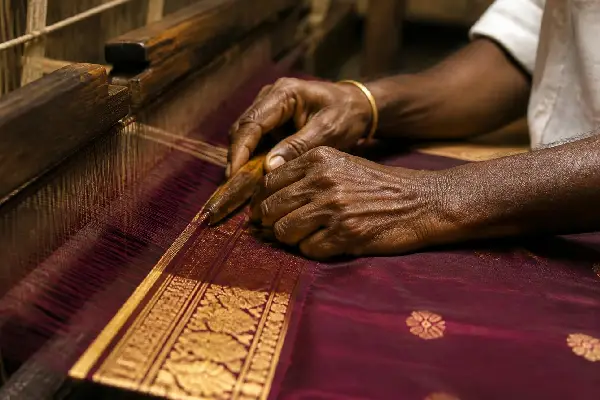
Why Handloom Sarees Take Weeks or Months to Weave
The main reason handloom sarees take weeks to weave is that most of the process involves manual work. Unlike industrial weaving, where machines can continuously produce large quantities of fabric, handloom weaving depends on the skill and pace of the weaver.
The time can increase when a saree includes:
- Intricate borders
- Multiple colours
- Silk yarn
- Special weaving techniques
- Fine-count yarn
- Detailed motifs
- Zari work
- Complex traditional patterns
- Elaborate pallu designs
A simpler cotton saree may require considerably less time than a heavily patterned silk saree.
Typical Time Required
| Type of Handloom Saree | Approximate Weaving Time | Factors Affecting Time |
|---|---|---|
| Simple cotton saree | Several days to a few weeks | Yarn, pattern and weave |
| Fine cotton saree | 1–4 weeks | Fine yarn and detailing |
| Handloom silk saree | Several weeks | Silk preparation and weaving |
| Intricate silk saree | 1–3 months or more | Motifs, zari and complexity |
| Highly detailed traditional saree | Several months | Complex designs and manual techniques |
*The actual time varies significantly by weaving tradition, design, material, and individual artisan.
The Handloom Saree Weaving Process
To understand how long it takes to weave a handloom saree, it is useful to look at the individual stages involved.
01
Selecting and Preparing the Yarn
The process starts with selecting suitable yarn based on the type of saree being produced.
Cotton, silk, wool, and blended fibres may require different preparation methods. The yarn must have appropriate strength and consistency so that it can withstand the tension created during weaving.
For fine sarees, even small variations in yarn quality can affect the final texture and appearance.
02
Dyeing the Yarn
If coloured yarn is required, it may be dyed before weaving.
The yarn needs to absorb the colour properly and achieve the desired shade. Depending on the weaving tradition and colour requirements, multiple shades may be prepared separately. After dyeing, the yarn needs to be dried and prepared for the next stage.
Colour combinations can also increase the complexity of weaving, especially when the design requires precise placement of different coloured threads.
03
Preparing the Warp
The warp refers to the lengthwise threads that run through the saree.
Preparing the warp requires arranging a large number of threads in the correct order and maintaining consistent tension. This is an important step because uneven tension can affect the quality and appearance of the finished fabric.
The number of threads and their arrangement depend on the desired width, density, and design of the saree.
04
Setting Up the Loom
Before weaving begins, the loom needs to be prepared.
The artisan carefully positions the warp threads and connects them to the appropriate parts of the loom. The setup can be particularly complicated for sarees featuring intricate designs.
This stage requires patience and technical knowledge. A mistake in loom preparation can affect the pattern throughout the fabric.
05
Weaving the Saree
This is where the weaver’s skill becomes most visible.
The artisan interlaces the warp and weft threads using the handloom. The weaver must maintain consistent tension, rhythm, and alignment throughout the process.
For a plain saree, the process may be relatively straightforward. However, intricate designs require much greater attention. Traditional motifs may need to be created thread by thread. Borders and pallus can also involve separate patterns that require careful coordination.
This is one of the biggest reasons handloom sarees take weeks to weave.
06
Creating Intricate Motifs and Borders
Detailed motifs are among the most time-consuming aspects of traditional saree weaving.
Depending on the technique, the artisan may need to manipulate individual threads to create flowers, geometric patterns, paisleys, traditional symbols, or other decorative elements.
A saree with a simple body and border can be completed faster than one featuring elaborate motifs across the entire fabric. The more detailed the pattern, the more attention the weaver must give to each section.
07
Weaving the Pallu
The pallu is often one of the most visually elaborate sections of a saree. It may contain:
- Dense patterns
- Zari details
- Decorative weaving techniques
- Contrasting colours
- Traditional motifs
Because the pallu can contain a high concentration of design elements, it may require additional weaving time.
08
Finishing and Quality Checking
Weaving is not necessarily the final step.
Once the saree is removed from the loom, it may require finishing, inspection, trimming of loose threads, and other preparation before it is ready for use. The saree should be checked for issues such as:
- Uneven weaving
- Colour irregularities
- Fabric damage
- Loose threads
- Pattern inconsistencies
- Finishing imperfections
Quality checking is particularly important for premium pure handloom sarees, where customers expect careful craftsmanship.
What Makes Handloom Sarees Different from Machine-Made Sarees?
The biggest difference is the method of production. Machine-made fabrics are generally designed for speed, consistency, and large-scale production. Handloom weaving operates differently. The artisan has greater involvement in the creation of the fabric, and the weaving process can vary according to the design and traditional technique.
| Feature | Handloom Saree | Machine-Made Saree |
|---|---|---|
| Production | Primarily manual weaving | Machine-based |
| Production speed | Slower | Faster |
| Craftsmanship | High artisan involvement | Automated / industrial |
| Design variation | Can involve complex traditional techniques | Usually highly standardized |
| Individual character | May have subtle variations | More uniform |
| Production quantity | Generally lower | Generally higher |
This does not mean that every machine-made saree is poor quality. Rather, the two production methods have different characteristics and purposes.
Does Longer Weaving Time Mean Better Quality?
Not necessarily.
The amount of time required to make a saree is influenced by several factors. A longer production period can indicate a complex design, fine material, or detailed craftsmanship, but weaving time alone should not be treated as a guarantee of quality.
When buying authentic handloom sarees, consider several factors together:
Material
Look at whether the saree is made from cotton, silk, or another fibre and whether the material suits your intended use.
Weave Quality
Examine the fabric for consistent weaving, neat finishing, and an overall balanced appearance.
Design Complexity
Intricate motifs, borders, pallus, and traditional patterns generally require greater weaving effort.
Craftsmanship
Details such as pattern alignment, finishing, and texture can provide useful clues about the workmanship.
Authenticity
Choose sellers who clearly explain the fabric, weaving technique, and product specifications.
Why Are Handloom Sarees Often More Expensive?
Many shoppers ask why a handloom saree price can be significantly higher than that of a mass-produced saree. The price reflects more than the fabric itself. It can include:
- Skilled artisan labour
- Quality of yarn
- Zari or decorative elements
- Dyeing and preparation
- Traditional weaving techniques
- Longer production time
- Silk or other premium materials
- Complexity of the weave
- Finishing and quality control
For example, a simple cotton handloom saree and a highly detailed handloom silk saree can have very different production costs. Therefore, comparing prices should always involve comparing the material, weave, craftsmanship, design, and finishing, rather than looking only at the price tag.
How to Choose the Right Handloom Saree
Understanding the weaving process can make shopping easier. Before purchasing, consider the following.
01
Choose the Material According to Use
Cotton handlooms are often suitable for everyday wear and warm weather, while silk sarees may be preferred for weddings, celebrations, and formal occasions.
02
Consider the Design
A minimal weave can offer an elegant everyday look, while elaborate borders and pallus can make a saree more suitable for festive or ceremonial occasions.
03
Check the Product Details
Look for clear information about fabric composition, weaving technique, saree dimensions, border and pallu details, zari or embellishment, and care instructions.
04
Understand the Price
A higher price may reflect premium material and extensive craftsmanship, but it is still important to compare product specifications and authenticity.
05
Think About Maintenance
Different fabrics require different levels of care. Silk sarees, in particular, may need careful storage and cleaning to preserve their texture and appearance.
How to Maintain a Handloom Saree
Proper maintenance can help preserve a handwoven saree for many years. Follow these general practices:
- Follow the manufacturer's care instructions.
- Keep silk sarees away from excessive moisture.
- Refold stored sarees periodically to reduce permanent creases.
- Use protective storage for zari and silk sarees.
- Avoid harsh detergents unless specifically recommended.
- Store sarees in a clean, dry environment.
- Avoid prolonged direct sunlight on delicate fabrics.
- For valuable sarees, consider professional cleaning.
Why the Time Behind a Handloom Saree Matters
When you purchase a handwoven saree, you are buying more than a finished piece of clothing. The fabric represents hours of preparation, weaving, design work, and careful finishing. A saree that takes weeks or months to create cannot be evaluated in exactly the same way as a mass-produced garment. The time involved is part of what gives many handloom sarees their distinctive character.
Final Thoughts
So, why handloom sarees take weeks to weave comes down to craftsmanship, preparation, materials, design complexity, and the pace of manual weaving.
From preparing the yarn and setting up the loom to creating detailed borders and pallus, every stage requires precision. Some simple handloom sarees may take days or weeks, while highly intricate silk sarees can take months.
For shoppers, understanding this process makes it easier to evaluate handloom saree quality, price, material, authenticity, and craftsmanship. A handloom saree’s value is ultimately shaped by the combination of its material, weaving technique, design, craftsmanship, and longevity.
Frequently Asked Questions
1.How long does it take to weave a handloom saree?
The time varies depending on the fabric, design, weaving technique, and level of detailing. A simple saree may take several days or weeks, while an intricate silk saree can take several months.
2. Why do handloom sarees take so long to make?
Handloom sarees require multiple manual stages, including yarn preparation, dyeing, warp preparation, loom setup, weaving, motif creation, and finishing. Complex designs take considerably longer.
3. Are handloom sarees better than machine-made sarees?
They are different rather than automatically better. Handloom sarees are valued for artisan craftsmanship and traditional weaving techniques, while machine-made sarees offer greater production speed and consistency.
4. Why are handloom sarees expensive?
The price can reflect skilled labour, production time, material quality, design complexity, weaving technique, zari, and finishing. Premium materials such as silk can also increase the price.
5. How can I identify an authentic handloom saree?
Check the seller’s product information, fabric details, weaving technique, and authenticity documentation where applicable. Pay attention to the weave, finishing, and consistency of the product description.
6. Do handloom sarees require special care?
Care depends on the fabric and embellishments. Silk and zari sarees generally require more careful storage and cleaning than everyday cotton sarees. Always follow the specific care instructions provided with the saree.
7. Does a longer weaving time guarantee better quality?
No. Weaving time is only one factor. Material quality, craftsmanship, weave consistency, design, finishing, and authenticity should all be considered when evaluating a handloom saree.