Blog
Ajrak Gharara or Sharara? A Practical Guide to Cut, Fit and Handwork Sets

If you searched for an Ajrak gharara and found an outfit listed as an Ajrak sharara, pause at the product description before choosing. The names are often used loosely in online browsing, but the cut of the trousers affects the shape, movement and fit of the finished outfit. The best choice comes from identifying the actual garment rather than treating the two terms as identical.
This guide explains what to compare, how to assess an Ajrak-inspired design and which measurements to request. It also shows how to use the Ajrak with handwork sharara set at The House of Karigari as a starting point for an enquiry without mislabelling the outfit as a gharara.
What is the practical difference between a gharara and a sharara?
In common clothing descriptions, a gharara has a more fitted upper leg and a pronounced flare introduced around the knee, often through a visible join or gathered section. A sharara is generally described as a wider trouser silhouette with a flare that is not defined in the same way by a fitted-to-knee construction.
Designers adapt these silhouettes, and retailers do not always use the names consistently. Look at the construction in photographs and ask where the flare begins. If the distinction matters to the look you want, a clear image of the trousers is more useful than a search label.
Ask to see the trousers separately
A long top, jacket or dupatta can hide the part of the outfit that distinguishes the cut. Request a photograph showing the trousers from waist to hem. Ask for a side view or a short walking video if the flare is difficult to judge.
Check whether the upper leg is fitted, whether there is a join near the knee and how much fabric opens below it. You do not need to become a tailoring expert. You need enough information to understand whether the silhouette matches your preference and how it will work with the rest of the set.
Ajrak or Ajrakh: read the design description carefully
Both spellings appear in searches and product names. For a purchase, establish whether the listing describes a documented printing process or an Ajrak-inspired visual design. A pattern associated with a craft tradition does not, on its own, prove a particular printing method, dye composition or place of production.
If the making process is part of your reason for buying, ask what information the seller can provide for this garment. Useful questions include whether the design is printed, how the handwork is described and what the base fabric contains. Avoid assuming that a craft reference in a name establishes natural dyes or handmade printing.
The Ajrak sharara set at The House of Karigari
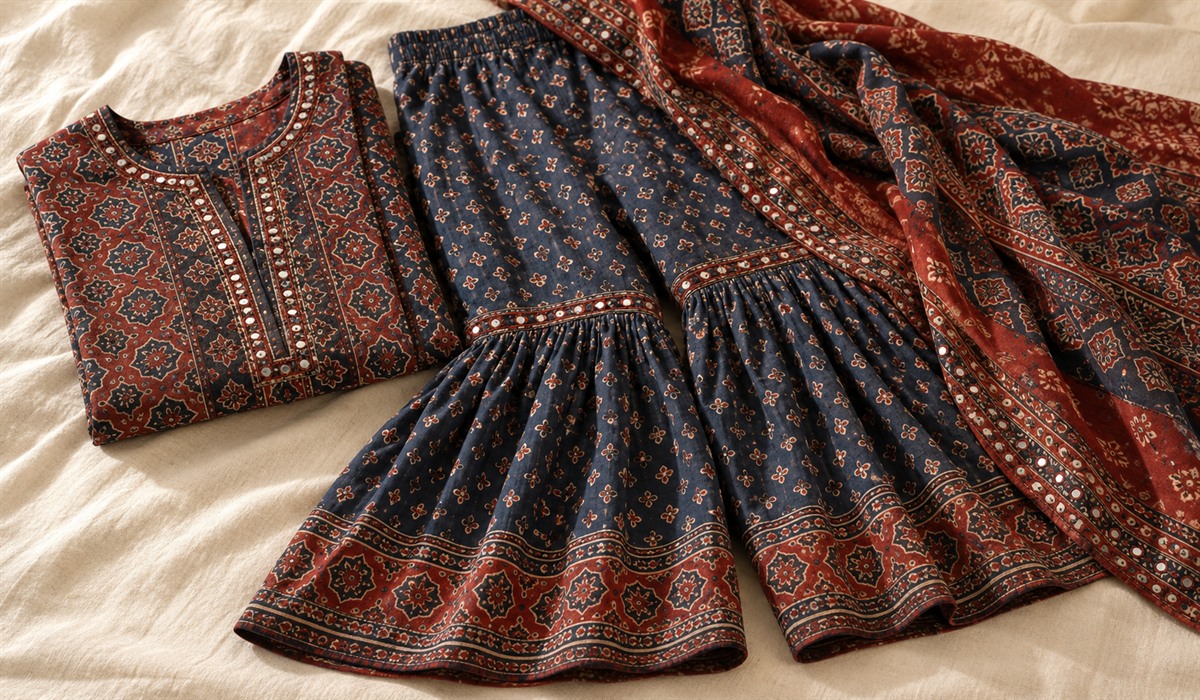
The Ajrak with handwork sharara set is listed as a sharara. Its description refers to Ajrak-inspired artistry and handwork. Keep that product name when making an enquiry so that the team can identify the correct outfit.
If you arrived through an “Ajrak gharara” search, ask whether the actual cut suits the silhouette you have in mind. Do not assume a search result changes the garment’s construction. Confirm current availability before making plans around a function, and request the measurements and included pieces for this exact listing.
Compare a separately listed gharara set
You can also compare the three-piece gharara set with handwork in the occasionwear selection. View it as a separate product, not a substitute with identical fabric, detailing or fit.
Ask the same questions for both outfits: what pieces are included, how are the trousers cut, what are the measurements, and what is known about the materials? Matching your questions makes the comparison fair even when the product descriptions have different amounts of detail.
Measurements that make an online enquiry more useful
Ask for garment measurements and how they were taken. A size label alone may not tell you the waist, hip, rise or length of the trousers. Confirm whether the waistband is fixed, elasticated or adjustable, and whether any alteration has been agreed.
For the top, ask about bust, waist, length and sleeve measurements where relevant. If the silhouette includes a fitted section around the upper leg or knee, ask for that measurement too. Compare the information with a well-fitting garment you already own, using the same measuring method.
Discuss the shoes you intend to wear when confirming trouser length. A hem that works with one pair may be inconvenient with another. If an alteration is needed, confirm who will do it and whether it changes the pattern placement or proportions.
Check what “set” includes
Do not assume that every accessory in a product photograph is included. Ask for a written list of the supplied garments. Confirm whether the dupatta, jacket, lining or other visible component forms part of the purchase.
This is also the time to ask how the handwork appears on each piece. A detail concentrated on the top creates a different balance from detail across the trousers or dupatta. Close-up photographs help you decide where to keep jewellery simple and where to add a focal point.
Style the pattern without competing with it
Begin with the part of the outfit you most want to show. If the pattern is the focus, choose accessories that leave it visible. If the handwork around the neckline is important, consider how a necklace will sit against it before choosing a heavily layered combination.
Check the outfit while sitting and moving. Decide how you will carry or secure the dupatta, if one is included. An arrangement that looks good while standing still may require repeated adjustment through a long function. Practise the full combination with your intended shoes before the event.
Care and storage depend on the actual garment
Ask for the care instructions for the base fabric and the handwork together. A printed surface, added decoration and lining may need to be considered as one garment. Do not assume that a washing method suitable for an unembellished fabric is appropriate for the finished set.
After wear, inspect the outfit before storing it. If cleaning is needed, follow the supplied instructions and tell the cleaner about the decoration. The general care guide is background information; the instructions for the particular set should guide the final decision.
Your Ajrak occasionwear buying checklist
- Confirm whether the product is a sharara or a gharara and view the trouser cut.
- Ask whether the Ajrak description refers to a documented process or an inspired design.
- Check fabric composition, lining and handwork details.
- Record garment measurements and included pieces.
- Confirm availability, delivery arrangements and any agreed alterations.
- Read the applicable shipping, returns and care information.
Explore the occasionwear collection or contact The House of Karigari with the product link and the silhouette you want. An accurate name and a few precise questions make it easier to choose an outfit that matches your expectations.