
Blog
How to Build a Bridal Saree Trousseau You Will Wear Beyond the Wedding

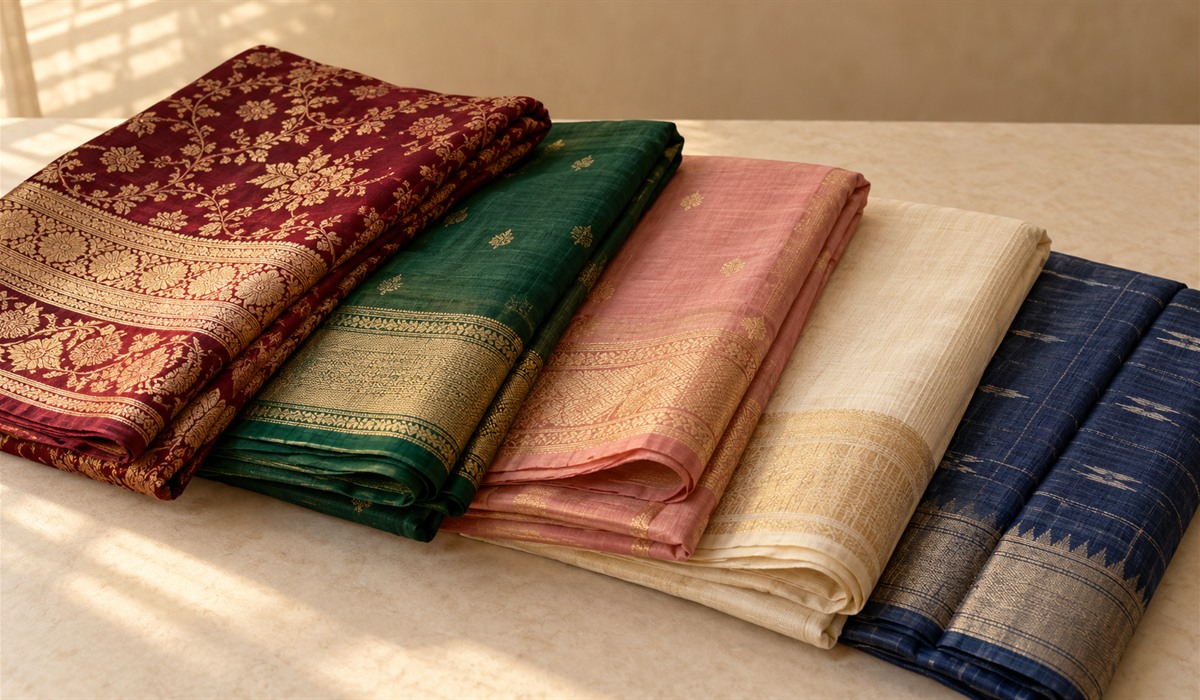
A bridal saree trousseau becomes useful when every piece has a reason to be there. It should work for your ceremonies, your personal style and the occasions you expect to attend afterwards. Building one around a fixed number of sarees or an imagined “complete” list often leads to repetition. Start with your actual needs and give each purchase a distinct role.
This is a practical planning guide for choosing bridal sarees without treating one colour, weave or budget as compulsory. It can also help a family member buying a gift: a clear brief is more valuable than guessing what a bride should own.
List events before listing sarees
Write down the ceremonies and gatherings for which you need an outfit. Include the time of day, venue, expected weather and any family or ceremonial requirements you have chosen to follow. Note whether you will be sitting, standing, travelling or changing clothes between events.
Then add the events you realistically attend in an ordinary year. That might mean family weddings, festivals or a few formal dinners. This second list helps you choose some pieces for continued use. There is no need to invent a large social calendar to justify another purchase.
Give every saree a clear role
A useful wardrobe may include a main ceremony saree, a reception option and a quieter piece for smaller celebrations. Another bride may need only one new saree and prefer to wear family pieces for other events. Both approaches can be thoughtful.
Describe each role in a sentence: “A saree for a daytime family ceremony that I can also wear to festivals,” or “An evening drape that works with jewellery I already own.” If two shortlisted pieces answer the same brief, compare them directly before buying both. A difference in colour is not always a difference in function.
Choose a ceremony saree around your priorities
For the main ceremony, decide what matters most to you. It may be a family colour, a particular weave, the detail of a pallu or a connection to a place. Share that priority when speaking to the boutique. It gives the team a better basis for selecting pieces than “show me bridal sarees.”
Explore the Kanjivaram collection and Paithani sarees as separate starting points. Compare the actual pieces rather than assuming that one collection is automatically heavier, more formal or more appropriate for every bride.
Red is an option, not an obligation
If you want a red bridal saree, look carefully at its undertone and the colours used in the border and pallu. Place it beside your jewellery reference and the blouse you plan to make. A red-and-green design produces a different overall effect from a red saree with quieter detailing.
If you prefer pink, ivory, yellow or another colour, use the same process. Check the requirements of your own ceremony and your preferences. A trousseau should reflect the person who will wear it. You do not need to buy a colour merely because it appears on a generic bridal shopping list.
Make the reception piece do a different job
If you are buying a separate reception saree, identify what should change from your ceremony look. You may want a different silhouette of drape, a simpler blouse or more emphasis on light-catching fabric. Writing that difference down helps avoid buying two outfits that feel almost identical once styled.
Compare the Tissue and Katan selection with Meenakari sarees. Request a moving view of any shortlisted piece. A fabric name and a folded photograph cannot tell you exactly how it will sit when pleated.
Allow room for repeat wear
Consider one piece that works with a simpler blouse and jewellery after the wedding. It does not have to be plain. The aim is to choose something you can imagine wearing to a specific future occasion, not a garment that requires another complete round of purchases.
Photograph the pieces you already own before shopping. Compare your shortlist with those images. You may discover that the gap is a different colour family, a different level of detail or a more manageable drape. You may also discover that there is no gap to fill.
Ask separately about fibre, weave and zari
These are different parts of a textile description. A saree can be described as handloom without that term establishing its fibre composition. A silk description does not automatically establish the composition of its zari. Ask the seller to state what is known about each component for the particular piece.
Request any relevant product documentation. The official Handloom Mark information explains the scheme’s role in identifying handwoven products. If a product carries an India Handloom Brand label, use the official registration-check guidance. This is a way to investigate a supplied label, not a claim that every saree in a collection carries one.
Build a complete budget before committing
Set a total you are comfortable spending and divide it by the roles in your plan. Leave room for blouse stitching, finishing and alterations. Include accessories only where you need them. Reusing jewellery or a well-fitting blouse can be a considered styling choice.
Compare current prices and confirmed details rather than judging quality by the highest price. Ask what is included and what must be arranged separately. If you are buying several pieces, record the information against each product link so that details do not become mixed together.
Keep a simple purchase record
For every selected saree, save the product reference, invoice, stated composition, dimensions, care instructions and details of any included blouse piece. Record the tailoring decisions separately. This will help you communicate clearly if a family member is collecting an order or if you are planning fittings remotely.
Confirm delivery and alteration arrangements before fixing a final fitting date. Do not assume that a product visible online is currently available in your preferred form. Read the shipping information and returns policy, then ask about your specific order.
Plan storage while you are planning outfits
Make sure each garment has suitable storage and clear care instructions. After a function, inspect it before putting it away. If it needs cleaning, follow the product instructions and consult a cleaner familiar with the fabric and embellishment. Do not use one washing method for every saree in the trousseau.
The existing silk saree aftercare guide is a useful place to begin, alongside the instructions for your chosen piece.
A final trousseau review
- Does each new saree serve a different role?
- Have you tried the intended drape and blouse together?
- Are composition, measurements and included pieces recorded?
- Have you budgeted for the complete outfit?
- Are the delivery and fitting arrangements confirmed?
- Can you name a future occasion for the pieces intended for repeat wear?
Browse the handloom saree collection or book a saree consultation with your event list and shortlist. A small, coherent trousseau is often easier to enjoy than a large collection built without a plan.